Why Are We Building Something That Could Surpass Us?
Human → created tools → tools amplified human power → AI amplified the human mind → robots replicated the human body → the two began to converge → powered by energy and resources, they started becoming increasingly autonomous → Mars could be the first real laboratory for this → so the question is no longer “What can AI do?” → but “Why does humanity want to create a civilization that can operate independently of us?”
AI, robots, Mars, and the possibility that humanity is building a civilization that may one day no longer need us.
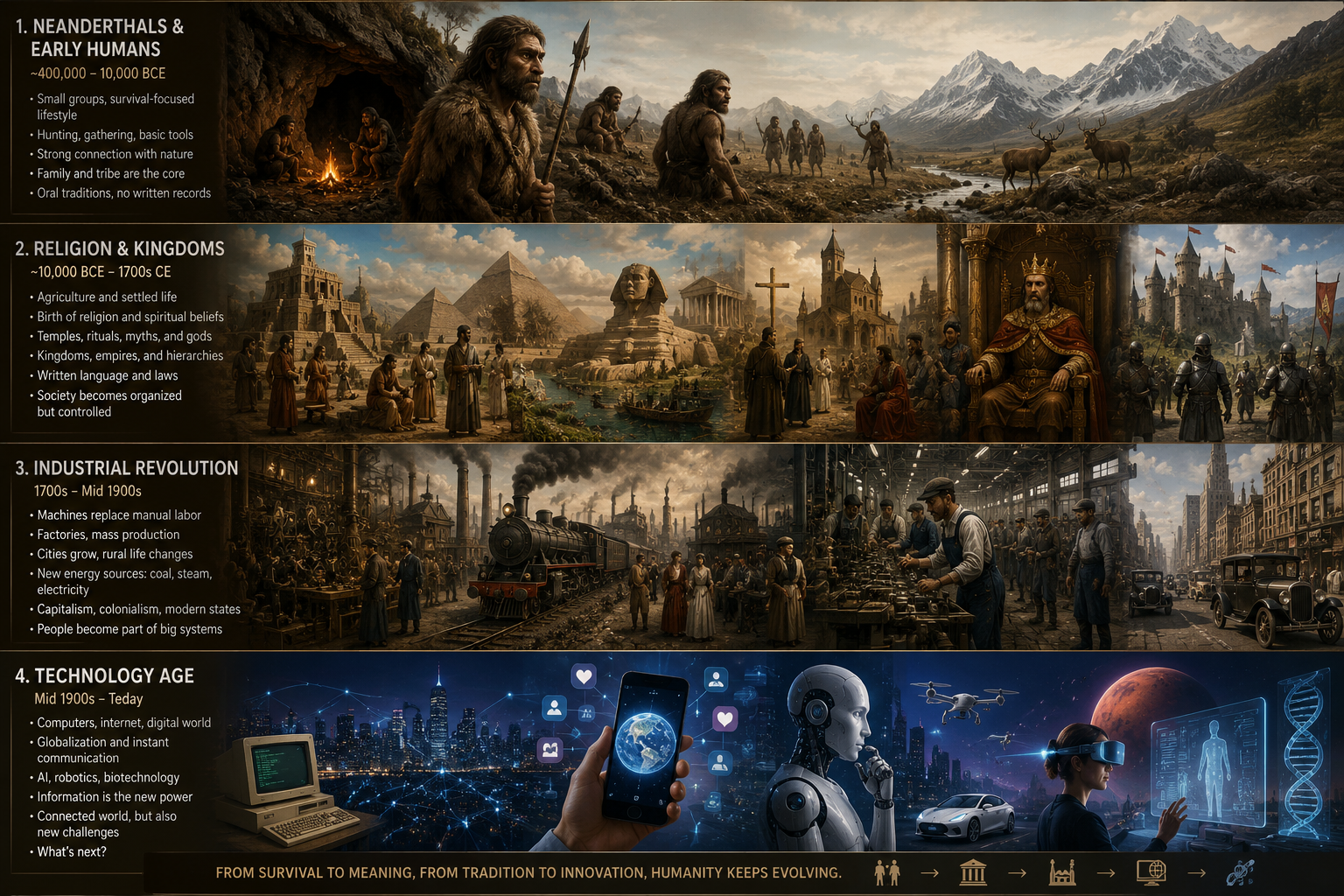
We usually tell the story of humanity through wars, kings, inventions, revolutions, and technological breakthroughs.
Maybe there is another way to look at it.
Maybe the entire story of humanity revolves around two very simple things:
Survival and transcendence.
Think about Maslow’s hierarchy of needs.
At the bottom are physiological needs: food, water, shelter, safety.
As we move upward, we find belonging, esteem, and eventually self-actualization.
Maslow’s pyramid is not a perfect model for describing entire societies. But it is an interesting metaphor for understanding human history.
Because while a large part of humanity has always had to spend enormous amounts of time dealing with the lower levels of survival, some people have had the privilege of spending more time thinking about what lies above them.
If your entire day is spent finding food, protecting your home, or doing physically demanding work, you have less time to wonder about the universe.
But once your basic needs are secured, different questions begin to emerge:
- Who am I?
- Why am I here?
- What will remain after me?
- Can I become more than I am?
Maybe as civilization developed, we didn’t just produce more resources.
We bought ourselves more time to think.
First, humanity had to survive
For early humans, much of life was about survival.
Hunting.
Gathering.
Finding shelter.
- Then we moved some of our survival problems outside the human body through technology and organization.
Industrial production scaled human labor.
Computers took over calculation.
The internet made communication almost instantaneous.
And now AI is arriving.
This time, what we are beginning to outsource is not just physical labor or calculation. Every major technological leap moved another part of human limitation outside the human body.
But technology wasn’t the only thing that changed us
Humanity didn’t only transform itself through machines.
We transformed ourselves through social systems too.
We created structures that determined how people lived, worked, married, raised children, exchanged resources, inherited wealth, and organized themselves.
For most of human history, our world was small.
Early human communities lived in relatively small, kin-based groups. We don’t know exactly how their relationship systems worked, but survival depended heavily on cooperation within the group. As societies grew, something changed: humans needed ways to organize people who no longer knew each other personally.
That is where social systems emerged.
Family structures, marriage rules, religion, laws, gender roles, traditions, and eventually states all helped societies coordinate larger groups of people. They didn’t all emerge for the same reason, and they cannot be reduced to one simple explanation. But together, they created shared rules about how people should live, reproduce, work, and belong.
For thousands of years, these systems were largely shaped by geography.
If you were born into a particular culture, your idea of what was “normal” was mostly defined by that culture.
There were different versions of these rules across societies. Some cultures heavily restricted female sexuality. Others imposed strict expectations around appearance, marriage, or motherhood. Men were also constrained by social expectations: strength, economic responsibility, status, leadership, and emotional restraint.
In many societies, the people at the top of the social hierarchy shaped these norms, while those norms helped reproduce the hierarchy itself.
Then something unprecedented happened.
Globalization, migration, international education, travel, the internet, social media, and global workplaces allowed people to see lifestyles that would previously have been almost invisible to them.
A person in Turkey could see how someone in Japan lived.
Someone in Dubai could date someone from Europe.
Someone in France could build a life in South Korea.
And people didn’t just exchange products.
They exchanged ideas, values, relationships, identities, and ways of living.
Suddenly, the word “normal” became questionable.
You could look at another culture and realize:
The way I was taught to live isn’t the only way to live.
Globalization makes us more similar.
We listen to the same music, use the same technologies, watch the same movies, wear similar clothes, use the same platforms, and increasingly share similar aspirations: freedom, travel, meaningful work, financial independence, love, and self-expression.
But at the same time, globalization creates something else:
hybrid identities.
For thousands of years, humanity moved from:
small groups → tribes → cities → religions → states → nations.
Now we seem to be moving toward:
nations → global networks → one connected information system.
Globalization connected humans to humans.
The internet connected information to information.
AI is beginning to connect human knowledge to machine intelligence.
Diversity has always been one of humanity’s greatest sources of creativity.
The real challenge may not be creating one global culture.
It may be learning how to build one global system while preserving billions of different ways of being human.
Maybe humanity’s next tribe won’t be defined by blood, geography, or religion.
Maybe it will be defined by ideas.
Then we look up at the sky
NASA’s robotics roadmaps have long explored robots as precursors to human exploration: exploring environments, identifying resources, preparing infrastructure, and supporting future human missions.
And this isn’t a new idea.
In 1992, Michael Duke and colleagues published work on the roles of humans and robots in Mars exploration and settlement, exploring how robotic systems could evolve from scientific exploration toward increasingly sophisticated support for human presence.
So sending a human to Mars isn’t simply:
“Put a person in a rocket.”
It’s closer to:
“How do we build a system in which a human can survive on another planet?”
The human becomes the starting condition of the system.
This is where science fiction begins to overlap with serious scientific thought.
The idea of self-replicating probes, often associated with von Neumann probe concepts, imagines machines capable of using resources in another planetary system to reproduce themselves and continue expanding.
We are nowhere near building such a system.
But the idea reveals something important:
A civilization could potentially expand physically without its biological species expanding with it.
Kardashev asked a bigger question: How much energy can we use?
In 1964, Nikolai Kardashev proposed thinking about advanced civilizations in terms of their energy use.
The concept later became widely known as the Kardashev Scale:
Type I — a civilization capable of harnessing planetary-scale energy.
Type II — a civilization capable of harnessing the energy of its star.
Type III — a civilization capable of harnessing energy on a galactic scale.
The framework is highly speculative, but it offers a fascinating thought experiment:
As a civilization grows, its energy requirements may grow with it.
“Can we build a self-sustaining system outside our natural environment?”
And perhaps the first workers in that system won’t be humans.
They will be machines.
Humans might arrive later.
Or maybe they won’t.
That second possibility is uncomfortable.
But it is also fascinating.
Because in that scenario, what reaches Mars isn’t necessarily humanity’s body.
It is humanity’s capability.
On a small planet.
Inside the minds of a fragile species.
Maybe humanity’s ultimate goal was never immortality.
Maybe it was to create something that could continue beyond humanity itself.
And perhaps what we are witnessing today isn’t simply a race to build better AI.
Maybe it is the moment when biological evolution begins creating a new kind of carrier for intelligence.
Something that doesn’t need our bodies.
Something that doesn’t share our lifespan.
Something that might eventually go where we cannot.
Which leaves us with a much stranger question than:
“Will AI replace us?”
The real question may be:
Why are we building something that could surpass us?
And if it does, will that be the end of humanity — or the furthest humanity has ever reached?
What If I’m Wired to Need More Stimulation?
Dopamine, novelty-seeking, creativity, and the hidden cost of never feeling “enough”
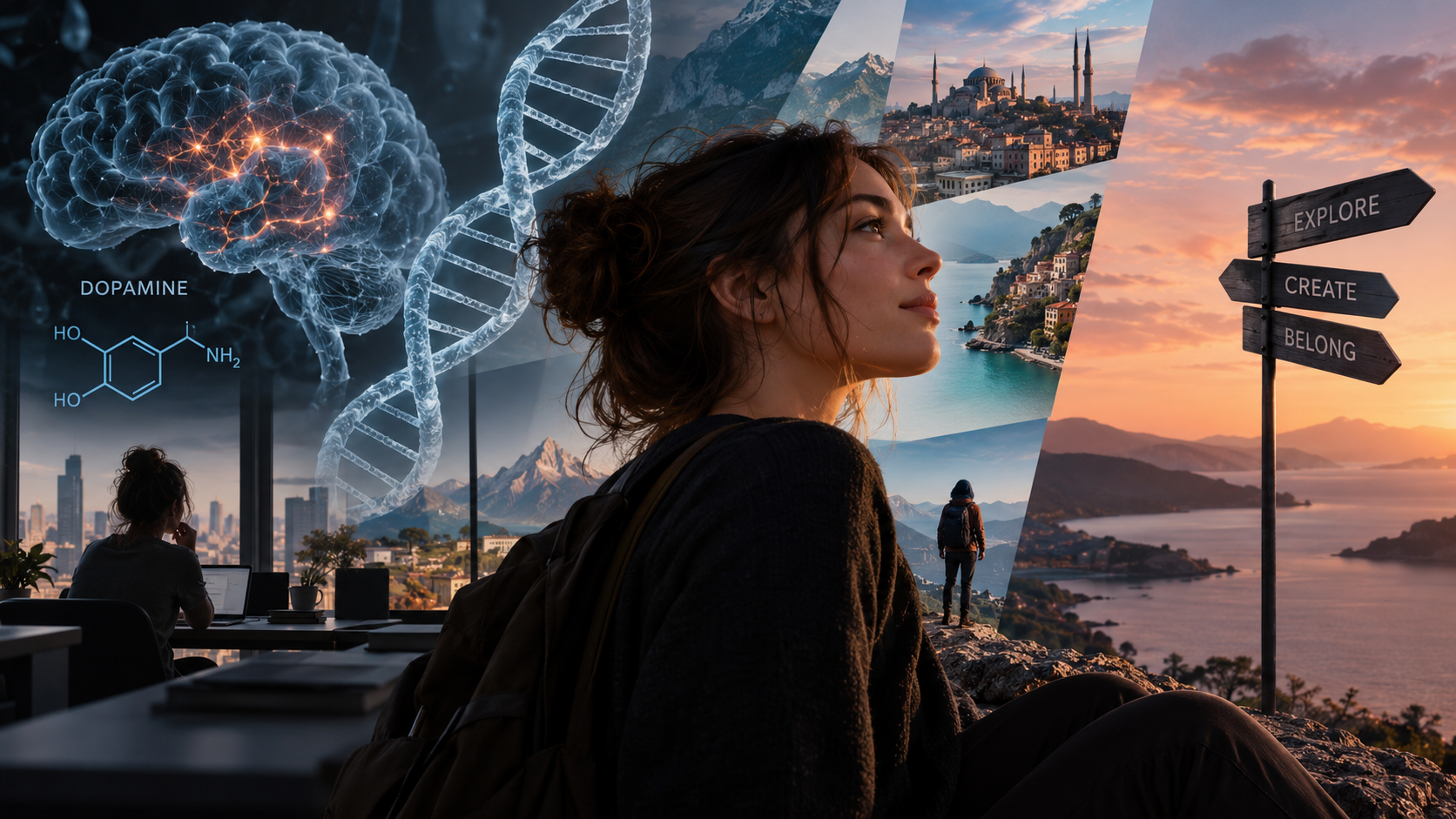
A few weeks ago, I did something slightly unhinged for a Tuesday night: I opened my Myheritage DNA test exported test file results and started googling gene names.
At first, I simply wanted to understand what some of my genes actually do. I started researching genes related to the dopamine system dopamine receptors, dopamine breakdown, transport, and the different mechanisms involved in how dopamine works in the brain.
Then the rabbit hole got a little more interesting.
I started wondering why some people seem to constantly seek new experiences. Why do some people get bored with routine so quickly? Why can traveling, meeting new people, starting new projects, discovering new cities, or even being in uncertain situations feel energizing rather than exhausting?
That’s when I came across concepts like novelty seeking, sensation seeking, and, more broadly, what we might describe as a stimulation-seeking temperament.
The more I researched it, the more I started recognizing parts of myself in the description.
But there is an important distinction to make.
It would not be scientifically accurate to say that my DNA test told me, “You are a stimulation-seeking person.”
Personality is influenced by genetics, but no single gene determines a personality trait or behavior. Personality emerges from the interaction of many genetic factors, brain development, environment, experiences, learning, and countless other variables.
So the more interesting question for me became:
Not “Do my genes determine who I am?” but “Could my biology contribute to certain tendencies in the way I experience the world and how can I use that knowledge to design my life better?”
And I think that is where things get really interesting.
What Exactly Is Stimulation-Seeking?
In simple terms, stimulation-seeking describes a tendency to seek out novelty, variety, intensity, exploration, and stimulation.
It is not simply about being unable to sit still.
Sometimes it is physical:
- New cities
- Travel
- Adventure
- Sports
- Festivals
- Nature
Sometimes it is social:
- Meeting new people
- Entering new social environments
- Discovering different cultures
Sometimes it is intellectual:
- Learning something new
- Solving a new problem
- Developing a new idea
And sometimes it is creative:
- Designing something
- Starting a new project
- Turning an idea into something real
So stimulation-seeking is not simply about “wanting more fun.”
It can be much broader than that.
It can feel more like:
“My brain seems to come alive when I encounter something new, meaningful, or unexpected.”
So What Does Dopamine Have to Do With It?
This is where things can easily become oversimplified.
Dopamine is often described as the “pleasure chemical,” but its role is much more complex than that.
It is involved in reward learning, motivation, approach behavior, attention, and the systems that influence what we choose to pursue.
That is why genes related to the dopamine system have been studied in relation to personality traits such as novelty seeking.
One of the most well-known examples is DRD4, which codes for the dopamine D4 receptor and has been studied for decades in relation to novelty-seeking behavior.
But science also teaches an important lesson here:
The first result you find is not necessarily the final truth.
Early studies suggested associations between certain DRD4 variants and novelty seeking. However, later studies have not always replicated those findings consistently.
That matters.
Because the interesting conclusion is not:
“I have this gene, therefore I am this way.”
It is closer to:
“Small biological differences may interact with my environment, experiences, and personality to influence certain behavioral tendencies.”
That is a much more nuanced and much more interesting way of looking at genetics.
What Might Life Look Like for a Stimulation-Seeking Person?
This is where I found the biggest paradox.
The same trait can be both a superpower and a weakness.
It can create completely different outcomes depending on how it is managed.
1. The Biggest Advantage: Curiosity
A stimulation-seeking mind may constantly ask:
“What else is out there?”
You arrive somewhere:
“What else can I discover here?”
You see a problem:
“What other way could we solve this?”
You meet someone:
“What is their story?”
You discover a technology:
“What could we build with this?”
That endless “what if?” mechanism can be incredibly powerful.
Novelty pushes us toward exploration.
And exploration is one of the raw materials of creativity.
Research has found connections between novelty seeking, traits such as openness and extraversion, and aspects of divergent thinking. More recent research also continues to explore the relationship between novelty, curiosity, and creativity.
But there is an important distinction:
Coming up with new ideas is one thing. Turning those ideas into something useful is another.
A Strong Foundation for Creativity
This is probably one of my favorite parts of the whole concept.
Experiencing new things, meeting different people, seeing different cultures, and moving between different disciplines gives the mind more raw material to work with.
For example, studying architecture and later moving into product design may look like two completely different worlds.
But for a stimulation-seeking mind, connecting:
Architecture + psychology + technology + UX + AI + art
can feel completely natural.
And maybe that is what creativity often is:
Putting two things together that previously did not seem to belong together.
But there is a trap here too.
Too much novelty can sometimes stop creativity rather than fuel it.
Because creativity is not only about generating ideas.
Choosing, developing, testing, iterating, and finishing are also part of creativity.
Being Great at New Beginnings
One of the places where a stimulation-seeking person can be incredibly powerful is the beginning.
New project?
New job?
New city?
New relationship
New hobby?
New idea?
When something is unfamiliar, the brain can suddenly become intensely engaged.
That can be a huge advantage in entrepreneurship, product design, creative work, research, innovation, strategy, and fast-changing industries.
But then…
Six months into the project, something changes.
It is no longer new.
There are details.
Documentation.
Repetition.
Optimization.
Execution.
And the brain starts asking:
“Okay… what’s next?”
That is where the real challenge begins.
The Biggest Downside: A Struggle With Stability
I think this is the darker side of stimulation-seeking.
Wanting something new is easy.
Deepening what you already have is harder.
Eventually, the initial excitement of almost everything fades.
The job.
The city.
The people.
The hobbies.
The projects.
Sometimes even life itself.
And it can be very easy to interpret that feeling as:
“I must have made the wrong choice.”
But maybe you didn’t.
Maybe the novelty effect simply wore off.
That distinction is huge.
Because if you don’t recognize it, you can spend your entire life chasing new beginnings without ever reaching the depth that comes from staying.
The Difference Between “I’m Bored” and “I Don’t Want This Anymore”
This may be one of the most important lessons I need to remind myself of.
When I become bored with something, I shouldn’t automatically assume that I no longer want it.
Because:
Boredom is a feeling.
Leaving is a decision.
They don’t have to be connected.
So when I feel the urge to make a major decision, I want to ask myself:
“Am I genuinely moving away from this, or am I simply trying to move toward something else?”
If I am only trying to escape what I currently have, I should probably wait.
If I am genuinely moving toward something that feels more aligned, then maybe it is a real choice.
The Most Dangerous Area: Relationships
I think this is where stimulation-seeking deserves the most attention.
Because a new person creates:
curiosity.
Uncertainty.
Anticipation.
Flirting.
Fantasy.
And all of those things can feel incredibly intense.
But as a relationship becomes safer and more stable, novelty naturally decreases.
That creates a very easy trap:
“I don’t feel as excited as I used to → maybe I don’t want this person anymore.”
But maybe what actually happened is simply:
“There is less uncertainty now.”
Intensity and intimacy are not the same thing.
Butterflies and compatibility are not the same thing.
Chasing and love are not the same thing.
And I think this is one of the biggest lessons for a stimulation-seeking person:
Sometimes calmness is not boredom. Sometimes it is safety.
Risk-Taking and Impulsivity
Another side of novelty and sensation seeking is a potential attraction to risk and intense experiences.
Sometimes seeking a new experience simply means:
“Let me try it.”
But sometimes it can become:
“I’m doing it regardless of what happens.”
Those are very different things.
The healthy side of stimulation-seeking is:
exploration.
The uncontrolled side can become:
impulsivity.
So my goal should not be to eliminate stimulation-seeking.
It should be to give it a steering wheel.
Why Stability May Be Especially Important
There is a beautiful paradox here.
Someone who constantly seeks stimulation may actually need stability more than they realize.
If everything around you keeps changing, your brain is constantly exposed to new stimuli.
But if the foundations of your life are stable, you can experience novelty without constantly rebuilding your entire life around it.
That is why I like thinking about an ideal balance as:
70% stability + 30% novelty
For example:
The same home.
A relatively consistent sleep schedule.
Financial structure.
A stable social foundation.
Regular exercise.
And on top of that:
New trips.
New projects.
New things to learn.
New people.
New experiences.
In other words:
Instead of constantly changing the foundation of my life, I can build new layers on top of it.
How Can a Stimulation Seeking Person Get the Most Out of Life?
This is probably the most valuable part of the whole research for me.
Because even if there is a biological tendency involved, the conclusion should never be:
“This is just who I am. There is nothing I can do.”
Quite the opposite.
It can be:
“This might be how my system works. So how can I design my life around it?”
Give Myself Small Doses of Novelty
I don’t need to change my entire life to feel stimulated.
I can create small changes:
- A new restaurant
- A new route
- A new book
- A new skill
- Meeting someone new
- A new city
- A creative side project
This allows me to satisfy my curiosity without constantly resetting my entire life.
Don’t Make Major Decisions When I’m Bored
This could become one of my personal rules:
The 72-Hour Rule
If I want to quit my job:
Wait 72 hours.
If I want to move to another city:
Wait 72 hours.
If I want to end a relationship:
Wait 72 hours.
If I want to suddenly invest all my energy into a new project:
Wait 72 hours.
During those 72 hours, I don’t necessarily have to change my mind.
I simply observe.
Because a temporary drop in stimulation is not necessarily a real problem with my life.
Learn to Finish, Not Just Start
This may be my biggest growth area.
I don’t want to ask myself only:
“What do I want to start?”
I also want to ask:
“What am I going to finish?”
Generating new ideas can be easy.
Taking one idea and developing it for years is much harder.
And real mastery usually lives on the other side of that difficulty.
Create a “Novelty Budget”
I love this idea.
Just like I have a financial budget, I can create a novelty budget.
A certain amount of new experiences every week or month.
For example:
- One new city every month
- One new activity every week
- One new skill every month
- One bigger creative project every quarter
- Regularly meeting new people
But outside of that, I keep my core systems stable.
It’s almost like telling my brain:
“I hear you. But we don’t have to burn the whole house down.”
Treat Deep Work as a Muscle
For a stimulation-seeking mind, staying focused on one thing for a long period can be challenging.
That is why deep work shouldn’t just be a productivity technique.
It is a muscle.
No phone.
No new ideas.
No endless browser tabs.
No new project.
Just one problem.
Because the goal isn’t to keep my brain constantly stimulated.
Sometimes the goal is to teach it the opposite:
“I can stay with something even when it isn’t immediately interesting.”
That may be one of the most valuable skills a stimulation-seeking person can develop.
Choose “Deeper People” Sometimes, Not Just “New People”
This applies beyond romantic relationships.
It applies to friendships too.
Meeting new people is easy.
Really knowing someone is hard.
Because depth requires repetition.
Having the same conversations over time.
Going through problems together.
Seeing each other on bad days.
Building trust slowly.
Stimulation gives us variety.
Stability gives us depth.
And I think a good life needs both.
Design My Career Around Stimulation
I think this trait can become a serious advantage in the right career environment.
Fields such as:
- Product design
- Innovation
- AI
- Startups
- Entrepreneurship
- Strategy
- Research
- Creative direction
- Consulting
- Emerging technology
- Cross-functional roles
often provide constantly changing problems.
But there is an important distinction:
Constantly solving new problems ≠ constantly changing jobs.
You can stay on a stable platform while solving completely different problems every year.
For me, the ideal career model might be:
A stable platform + changing problems.
That could be the perfect combination for a stimulation-seeking mind.
Turn Creativity Into Production, Not Escape
New ideas shouldn’t exist only as entertainment.
They need to become something.
When an idea appears, I want to put it through:
Idea → Prototype → Test → Iterate → Finish
Because maybe the most beautiful version of novelty isn’t:
“I discovered something new.”
Maybe it is:
“I turned something new into something real.”
Give Myself Permission to Be Bored
Maybe this is the hardest one.
Don’t fill every empty moment.
Don’t reach for my phone.
Don’t look for a new person.
Don’t make a new plan.
Don’t buy something new.
Don’t start another project.
Sometimes just sit.
Walk.
Think.
Be bored.
Because if my brain receives new stimulation every time it becomes bored, I never develop a tolerance for low stimulation.
My goal isn’t to eliminate my need for stimulation.
My goal is to gain control over it.
And Maybe This Is the Most Important Thing I Learned
Genes are not destiny.
But understanding our tendencies can still be incredibly powerful.
Our genetic makeup does not explain our entire personality.
A single DRD4 variant cannot tell me:
“This is who you are.”
Personality is much more complicated.
Genes + brain + environment + experiences + learning + habits + choices.
All of these interact to shape who we become.
But if I recognize that I may have a strong tendency toward novelty and stimulation seeking, I don’t have to fight it.
I can design my life around it.
My ideal formula now looks something like this:
Novelty without chaos.
Creativity without distraction.
Adventure without impulsivity.
Stability without stagnation.
Depth without losing curiosity.
Because maybe the goal isn’t to want less.
Maybe the goal is to build a life that works for a mind that wants a lot.
Final Thought
For a long time, I sometimes asked myself:
“Why does nothing ever feel like enough for very long?”
Maybe that was the wrong question.
Maybe the better question is:
“What kind of life would actually be enough for the way my mind works?”
Some people grow by putting down roots.
Some grow by moving.
And some people need both.
I no longer think I need to force myself to belong to one place, one identity, one routine, or one definition of stability.
Maybe what I need instead is to give myself both:
roots and wings.
Roots:
stability.
Wings:
novelty.
And perhaps real freedom isn’t about choosing between the two.
It is about building a life capable of carrying both at the same time.